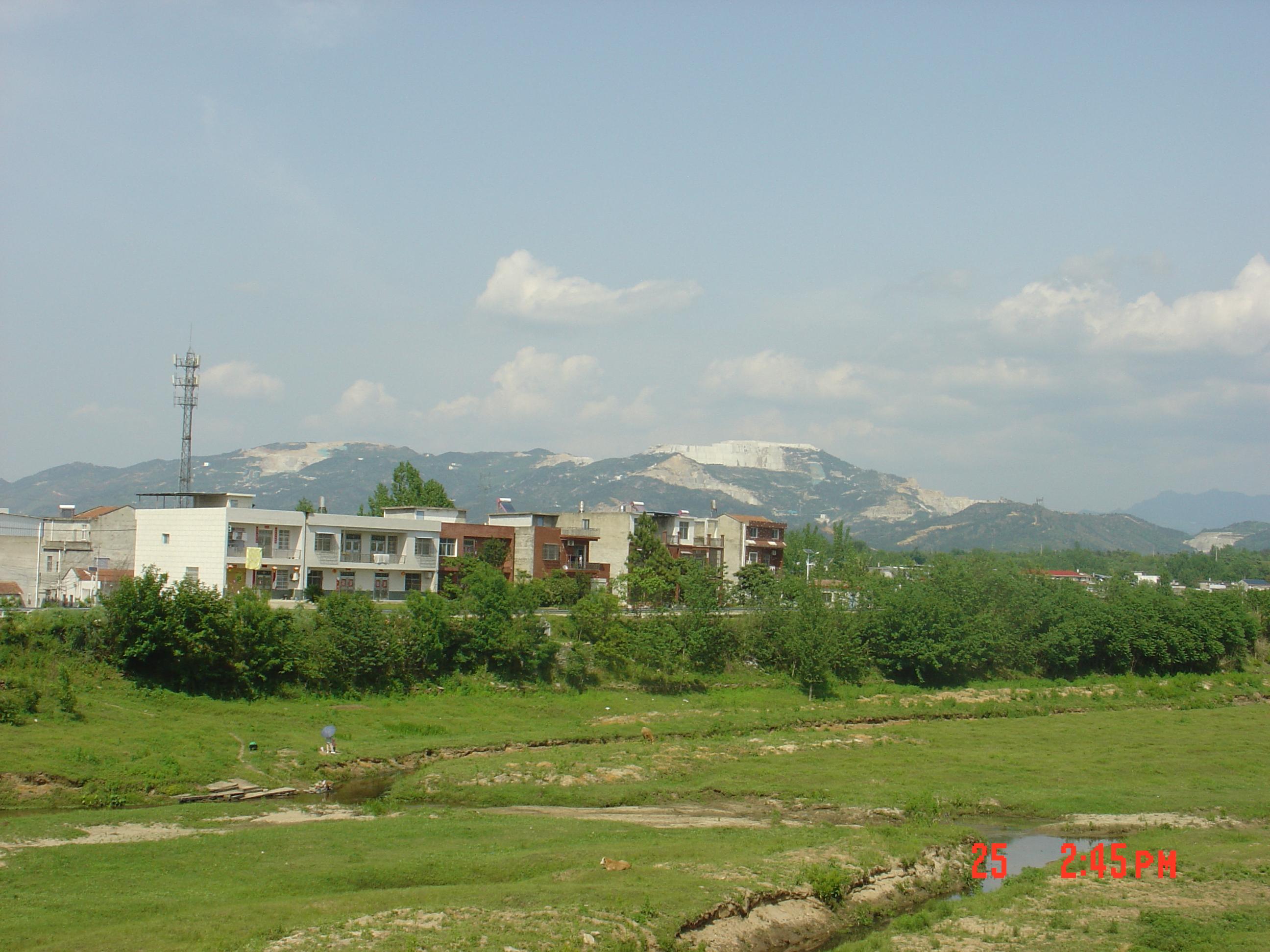
White Duck Mountain, Macheng City, Huanggang, Hubei Province
The dazzling white mountain in the distance, captured by the lens, is White Duck Mountain (Baiyashan) in Macheng, Huanggang, Hubei—one of the largest single‑body granite mines in China.
Geographical Location: White Duck Mountain is located within Macheng City, Huanggang, Hubei Province, southeast of the urban area. It straddles several townships, including Guishan Town, Baiguo Town, and Nanhu Subdistrict. As the core natural mountain in central Macheng, it is a well‑known local landmark. The mountain is very close to downtown Macheng with convenient transportation. Surrounded by rolling hills and open terrain, it forms a complete natural mountain space based on the local hilly landform. It is a representative large single‑body mountain in the eastern Hubei hill region, with scattered villages and farmlands around it, embodying both natural scenery and rustic charm. Its unique location makes it a typical representative of Macheng's natural landscape.
Origin of the Name: White Duck Mountain was called Baijiang Mountain in ancient times. Over thousands of years, the name gradually evolved to the current “White Duck Mountain,” with a rich cultural background combining historical records and local folklore. According to historical records, the mountain was named after the Bai family who settled here in ancient times; thus, the old name Baijiang Mountain was based on the surname. This ancient name has been preserved in Macheng's local chronicles and ancient geographical texts. A gentle local legend says that in ancient times, white ducks often rested and wandered among the mountain springs, deep valleys, and dense forests. The local people saw them every day and straightforwardly named the mountain after the white ducks. Passed down from generation to generation, the name “White Duck Mountain” was finally established. The simple and down‑to‑earth name reflects the local people's deep feelings for this mountain, and it has been kept intact to this day, making it one of the best‑preserved ancient mountain names in Macheng.
Geology and Landform: White Duck Mountain is a natural granite body formed by hundreds of millions of years of geological movements. It is a large and structurally complete single‑body granite mountain range in the eastern Hubei region, with an extremely long geological history. It underwent crustal movement, rock compression, weathering, and erosion in ancient times, eventually resulting in today's majestic and solid appearance. The mountain has a vigorous outline, rolling ridges, a moderate summit elevation, and a combination of gentle and steep slopes. The rock layers are compact, with exposed granite in many places. The whole body is composed of high‑quality granite with abundant reserves, hard and fine in texture, making it a natural high‑quality stone resource. The mountain features diverse landforms, including steep cliffs, gentle slopes, deep valleys, natural rock fissures, and spring‑fed ravines. The surface soil layer is of moderate thickness, and the natural geological structure is stable. After thousands of years of rain and weathering, it still retains its original mountain landscape without excessive artificial damage, perfectly preserving the original texture of the natural geology—highly representative of the eastern Hubei mountain geology.
Historical Significance: White Duck Mountain has a profound history of over a thousand years. Since ancient times, it has been an important natural landmark in Macheng and has played a pivotal role in the city's thousand‑year development. For centuries, the mountain has silently guarded the land and nourished generations of people. Villagers have worked, rested, and sought seclusion here, making it the natural home upon which locals depend. In ancient times, scholars, local gentry, and refined individuals came here to climb high, express their emotions, and enjoy the scenery, leaving many cultural traces. Detailed records about White Duck Mountain can be found in Macheng's local historical materials, gazetteers, and genealogies, witnessing the changes and cultural development from ancient times to the modern era. Through dynastic changes, White Duck Mountain has stood steadily, witnessing the rise of surrounding villages and the flourishing of local culture. It carries Macheng's native history and folk heritage and is a historical nostalgia engraved in the bones of Macheng people. It is an indispensable natural vessel for local historical and cultural inheritance, imbued with a rich flavor of vernacular history.
Natural Ecology and Scenery: Located in a subtropical humid monsoon climate zone, White Duck Mountain enjoys four distinct seasons, a mild climate, abundant rainfall, and ample sunshine. The ecological environment is tranquil and natural. Vegetation thrives with extremely high coverage, including various native trees, shrubs, wildflowers, grasses, and green vines. The plants change with the seasons: lush green in spring and summer, and gradually changing colors in autumn and winter. The mountains are verdant, the air is fresh, and the pristine natural environment is excellent. Natural mountain springs flow all year round, gurgling with clear, cool water that never dries up. Winding along valleys and rock crevices, the springs nourish everything on the mountain, forming beautiful scenes of clear springs, secluded valleys, and a harmonious blend of mountain and water. Birds and animals inhabit the mountain, and life flourishes everywhere, creating pristine natural beauty without noise or disturbance. Climbing high and looking into the distance, you can overlook the entire urban and rural landscape of Macheng, with distant mountains and nearby waters all in view. The scenery varies in each season, each with its own unique landscape, fully displaying the simplicity and elegance of nature.
Cultural and Folk Heritage: White Duck Mountain is deeply rooted in Macheng's local folk culture and serves as an important carrier of the region's traditional customs and folk arts, embodying the rich vernacular culture of eastern Hubei. For thousands of years, people have lived by the mountain and made a living from it, creating unique mountain customs, lifestyles, and folk legends. All these cultural elements are simple, pure, and closely connected to local life—a true microcosm of eastern Hubei's vernacular culture. This mountain is an important part of Macheng's ancient scenic culture and lies within the core area of traditional Macheng landscapes. Since ancient times, it has been known for its famous natural scenery and is revered by locals as a place of spiritual beauty and respected by the people. Ancient cultural remnants remain here, still retaining an archaic humanistic atmosphere after centuries of weathering, carrying the spiritual beliefs and emotional attachments of the local people. During seasonal festivities, nearby residents spontaneously climb the mountain to enjoy the scenery and embrace nature, integrating their reverence for the landscape and love for their homeland into daily life. This has been passed down for generations, keeping the culture and folk customs of White Duck Mountain vibrantly alive. It has become an inseparable part of Macheng's local culture and carries the native memories and emotional bonds of one generation after another.
Overall Character and Value: White Duck Mountain is a natural mountain area that integrates geology, ecological scenery, historical culture, and vernacular folk customs. It is not only an iconic natural landmark of Macheng but also a model of harmony between local humanities and nature. Without excessive commercial development, it always maintains a simple and genuine appearance. Mountains, water, culture, history, and geography are perfectly blended here. It has both unique natural endowments and a profound humanistic heritage, making it a distinctive and highly recognizable natural mountain in Macheng. It nourishes the land and people, and carries the thousand‑year cultural roots and native emotions of Macheng. It is an irreplaceable hometown landscape in the hearts of Macheng people. The overall style is unspoiled and down‑to‑earth, with profound cultural connotations and tranquil natural scenery, fully showcasing the unique charm of the eastern Hubei mountains. It is the most representative and lively natural mountain in Macheng.